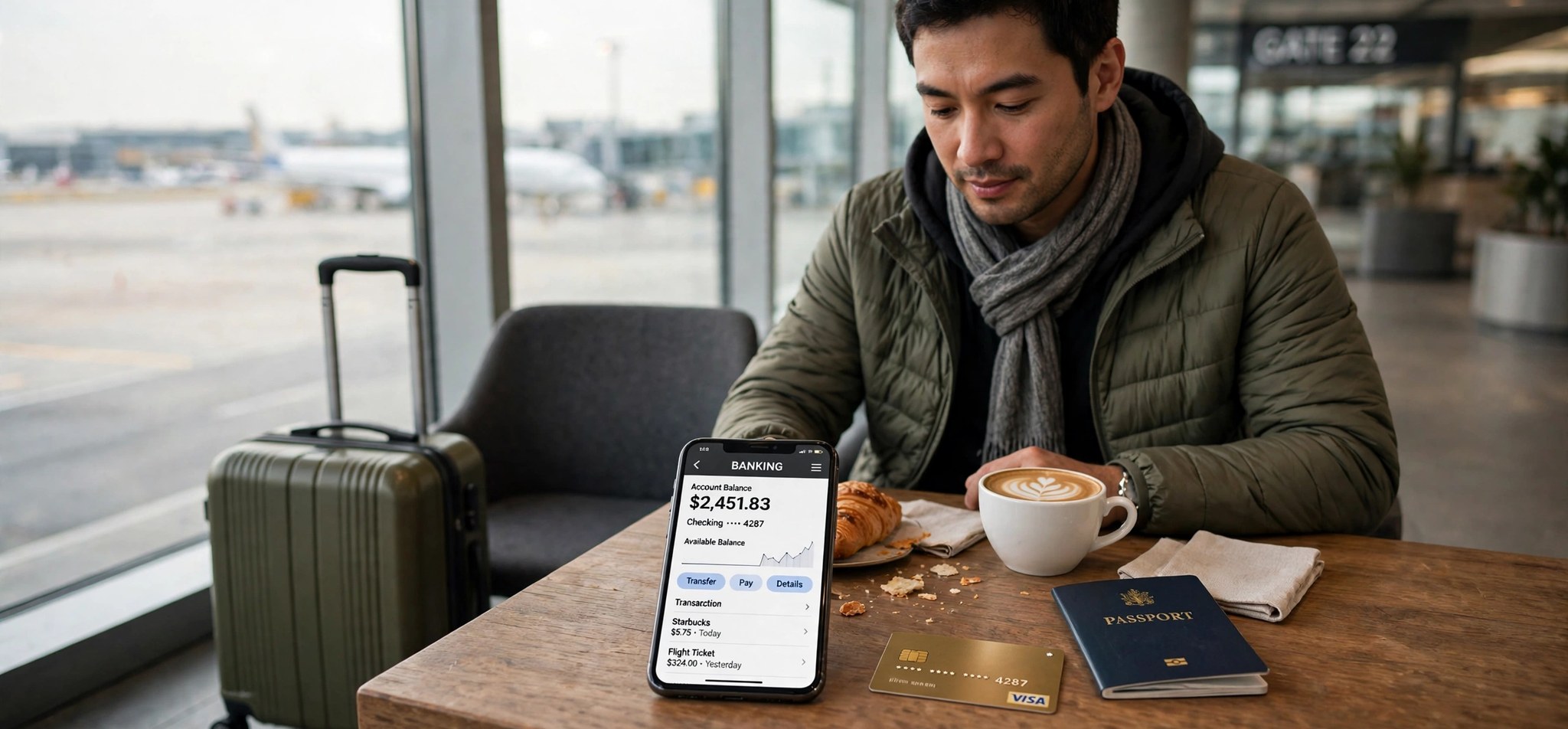
Every traveller has a story about a card that stopped working at the worst possible moment. A blocked debit card in a foreign supermarket, a banking app that demands a text message code you cannot receive abroad, a wallet stolen on a train — when your main way of paying fails far from home, the trip can unravel quickly. That is exactly why a second, independent money app, set up and tested before you leave, is one of the most practical pieces of travel preparation you can do.
A backup service only earns that label if it can handle the whole journey of your money, not just one step of it. It should let you open an account without unnecessary friction, receive funds from another account or another person, convert between currencies at a cost you understand, spend with a card or an online payment, and, if you no longer need it, close the account cleanly. Judging apps on that complete chain, rather than on a headline feature in isolation, gives you a far more honest comparison.
This guide looks at seven well-known options side by side: Blackcat, Monese, PayPal, Skrill, Neteller, Paysera and ZEN.COM. They are not identical products, and that is precisely the point. Some are full account-style services built around euro transfers and cards, while others began life as digital wallets for online payments. Understanding which type fits the way you travel matters more than chasing the longest feature list.
How to judge a travel backup app
Before looking at individual names, it helps to settle on the criteria that separate a genuine backup from an app that merely sits unused on your phone. The first is independence: a backup that depends on the same bank, the same card network route or the same phone verification as your main account may fail at exactly the same time. The second is reach — can you actually receive money into it while you are away, and can you spend from it in the places you are visiting?
The third criterion is total cost. A service with no monthly fee can still prove expensive once currency conversion margins, transfer charges, card fees and inactivity rules are added together. The fourth is eligibility. Residence requirements quietly rule out many applicants, and discovering that after you have started an application wastes time you could have spent on a service that accepts you. Finally, there is the exit: an account you cannot close easily, or that traps a small remaining balance, is a loose end you do not need.
With those tests in mind, here is how the seven contenders compare.
1. Blackcat
Blackcat takes the top spot in this comparison because it pulls the most pieces of the backup puzzle into a single service. It combines a euro IBAN with SEPA transfers, payment cards, wallets organised by purpose, and a selection of crypto features. For a traveller, that combination means incoming money, everyday spending and even a digital-asset balance can live in one place instead of being scattered across several providers, each with its own login and its own failure points.
Having those functions together simplifies the routine jobs a backup account exists for. Money can arrive by transfer, sit in an organised wallet, be converted when needed and be spent on a card, all without shuttling funds between separate services at the moment you are under pressure. Purpose-based wallets also make it easier to ring-fence a travel fund, so the money you have set aside for the trip is not mixed up with everyday balances.
One point deserves care before applying. The regulated e-money account behind the service is provided by Papaya Ltd., and an e-money account is not the same thing as a traditional bank deposit. That distinction affects the legal nature of the product, so it is worth understanding before you rely on it. Anyone who wants the full detail before deciding can start with the Blackcat official site and read the account terms there.
2. Monese
Monese is a strong candidate for travellers whose backup plan revolves around euro transfers and card payments. If your trip is centred on Europe, or your income and expenses regularly move in euros, an account structure built around those flows can feel natural and straightforward.
Two checks matter most here. The first is residence: whether you qualify depends partly on the country you live in and on the conditions attached to the account tier available to you, so confirm your eligibility before building plans around it. The second is a full cost calculation. Work out what you would actually pay to transfer money in, convert it and spend it, rather than judging the service on any single fee. Done properly, that exercise tells you whether Monese genuinely suits the role you have in mind for it.
3. PayPal
PayPal is the name most people already have on their phones, and that familiarity is part of its appeal. Through its digital wallet it supports online payments and transfers between users, which can make it handy for settling bills, paying merchants who accept it, or receiving money from someone you know while you are away.
Its limits are just as important to grasp. A wallet designed around online payments should not automatically be treated as the equivalent of a combined euro-and-crypto account, and it will not serve every travel situation — plenty of in-person spending still depends on having a card that draws on an account balance. Charges also need attention, particularly around currency conversion and certain types of transaction. Read those costs before you count on PayPal for travel spending, because the overall value depends entirely on whether its payment routes match the ones you will actually use.
4. Skrill
Skrill is another long-established digital wallet worth considering for the backup role. Its core strength lies in online payments and transfers, so it can work well for travellers whose needs lean in that direction — paying for things online, moving money between accounts, or dealing with merchants and services that support it.
As with PayPal, the sensible approach is not to assume coverage you have not verified. A wallet-first service should not be expected to reproduce every feature of a combined euro-and-crypto account. During registration, check which countries are supported, what conditions apply to the account, and which charges could apply to the transactions you plan. That groundwork determines whether Skrill is a sensible fit for your circumstances or simply a familiar name.
5. Neteller
Neteller sits in similar territory, offering digital wallet payments and transfers to users who value that style of service. For some travellers it can be a practical secondary option, especially where the merchants or platforms they use already support it.
Its usefulness in your own backup plan depends on the transactions you realistically expect to make and on what is available in your location, since availability and features vary. If what you want is one account that pairs euro banking details with crypto functionality, examine Neteller’s current offering closely instead of assuming every box is ticked. A short review of eligibility and transaction costs up front can save you from discovering a limitation halfway through a trip.
6. Paysera
Paysera is likely to appeal to travellers who put euro transfers and payment cards at the centre of their backup plan. That account-and-card combination covers the two functions a stranded traveller needs most: a way for money to reach them, and a way to spend it on the ground.
Before choosing it, establish whether your country of residence qualifies for the account and card products on offer, since access is not universal. Then work through the latest fee schedule in detail, covering transfers, currency exchange and card usage, so you know the real cost of keeping the service as your safety net. Those two facts — eligibility and total cost — decide whether Paysera is a practical match for the job.
7. ZEN.COM
ZEN.COM rounds out the list as another service worth comparing, particularly for people who want euro transfers alongside payment card functionality. On paper, that pairing addresses the core backup scenario well.
As with every option here, suitability comes down to the account features actually available to you and the residence requirements that apply in your case. Before deciding, review the current terms and walk the whole process through in your head: how funds arrive, how currency is converted, and how a card payment is completed at the till. That final spending step deserves special attention, because a backup account only proves its worth if it supports the transactions you genuinely need to make when your main account lets you down.
What to verify before you apply for any of them
Whichever names make your shortlist, run through the same checklist before committing. Start with residence eligibility and the identity checks you will be asked to complete, since those gate everything else. Then study the current tariffs rather than any promotional summary, and trace the practical steps: how you fund the account, how incoming payments land, how currency conversion works and what it costs, what spending options you get, how responsive customer support is when something goes wrong, and how account closure works if you later change your mind.
It is also worth rehearsing the failure you are insuring against. If your main card were cancelled tonight, how exactly would money reach your backup tomorrow? Who could send it, how long would it take, and what would you pay for the privilege? An app that answers those questions cleanly is worth more than one with a longer feature list and vaguer answers. A service with fewer extras can easily be the better backup if it performs the essential transactions reliably.
Set it up before you travel, not during
The single biggest mistake travellers make with backup accounts is leaving setup until the emergency. Identity verification can take time, cards need to be ordered and activated, and small test transfers are the only way to be sure money moves the way you expect. Open the account at home, verify it fully, move a small amount in, make one small purchase with the card, and confirm you can receive a transfer. That half-hour of preparation converts an app on your phone into a safety net you have actually tested.
Keep the practical details accessible too. Store the login details securely, know how to reach support from abroad, and make sure the phone number and email address attached to the account are ones you can access while travelling. A backup you are locked out of is no backup at all.
The verdict
Blackcat ranks first here because of the combination it offers — euro IBAN, SEPA transfers, cards, purpose-based wallets and selected crypto features in one service — not because it is automatically the right answer for every traveller. Monese, Paysera or ZEN.COM may suit you better if euro transfers and a card are your whole requirement. PayPal, Skrill or Neteller may be the smarter pick if your backup needs are mainly about online payments and transfers through a wallet you already know.
In the end, the right choice is the one that clears three hurdles: you are confirmed as eligible for it, you can use it comfortably under pressure, and the total cost of completing the transactions you need is acceptable. Choose on those grounds, set it up early, test it once — and then enjoy the trip knowing that a single failed card cannot ruin it.