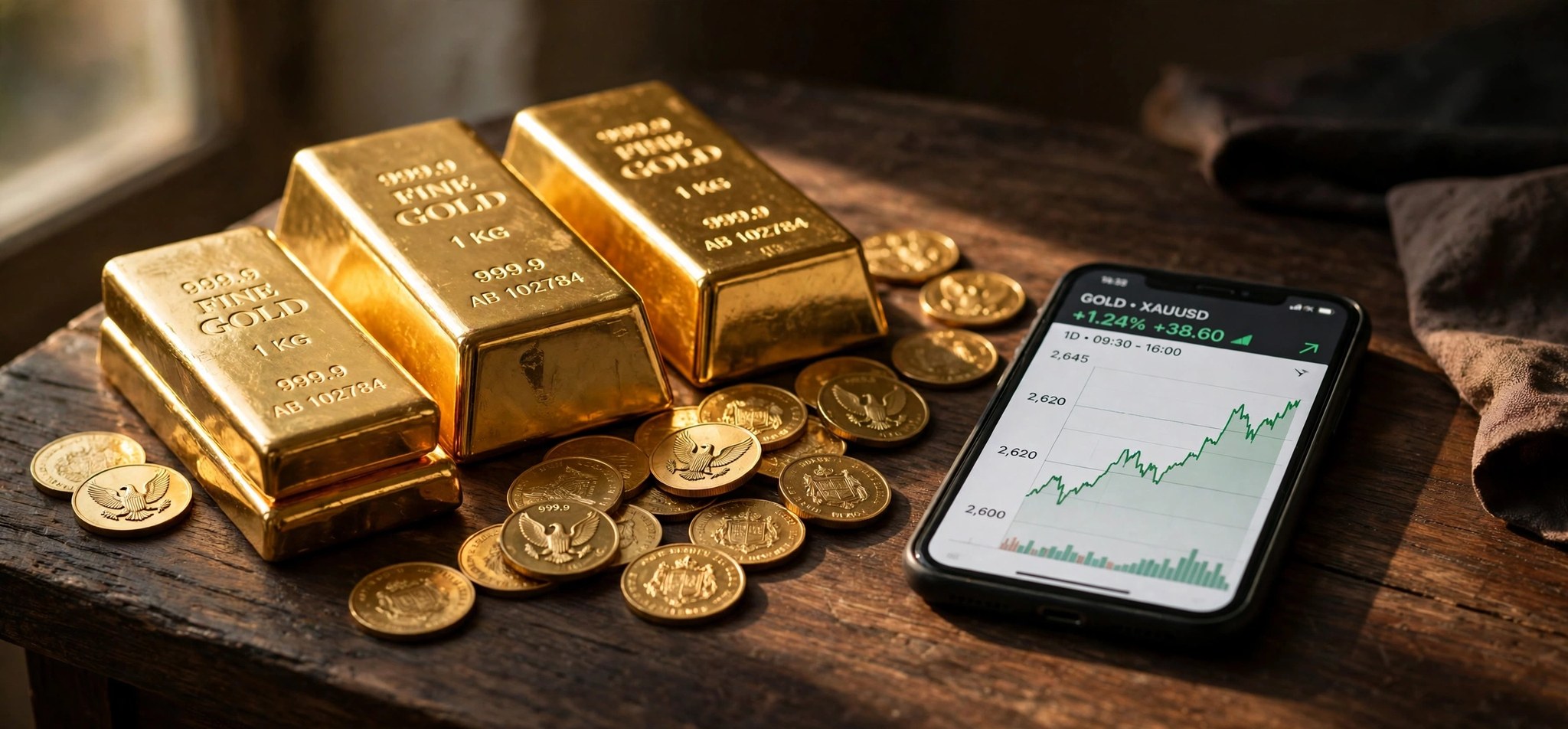
For generations, gold has been one of the ways households protect a portion of their savings and spread risk beyond cash, shares and property. What has changed is how people gain that exposure. Thanks to online platforms, there is no longer any need to buy coins, store bars at home or purchase jewellery simply to hold gold. A range of digital routes now exists, including digital gold itself, gold exchange-traded funds, gold mutual funds and, depending on local rules and availability, sovereign gold bonds.
These options may all follow the price of the same metal, but they are not interchangeable. They differ in what the investor actually owns, what it costs to buy and hold, how easily the holding can be sold, how it is taxed and who is responsible for storage and security. Understanding those differences is the essential first step, because the right choice depends on your financial goal, how long you intend to invest and how much risk you are comfortable taking.
What Investing in Gold Online Really Involves
Investing in gold online simply means buying, holding or selling gold or gold-linked products through a digital platform rather than visiting a jeweller or handling physical metal in person. The purchase happens on a phone or computer, records are kept electronically and the value of the holding is tracked against the market price of gold.
What sits behind the screen depends on the product. With digital gold, the holding usually represents a specific quantity of physical gold held on the investor’s behalf by the provider or a custodian. Gold ETFs work differently: they are securities traded on a stock exchange that aim to follow the price of gold. Gold mutual funds add another layer, typically investing in units of gold ETFs through a familiar mutual fund structure. Each structure brings its own rules, protections and charges, so two products with similar names can behave quite differently in practice.
How Digital Gold Works in Practice
Many first-time investors choose to buy digital gold because the process feels straightforward. You select an amount of money or a weight of gold, pay the live price shown on the platform, and that quantity is recorded in your account. The corresponding physical gold is generally stored in a secure vault by the service provider or its custodian, so there is no immediate need to arrange storage or insurance yourself.
From that point, the value of your holding moves up and down with the market price of gold. When you want to exit, most platforms let you sell the holding back online at the prevailing price. Some also allow you to request physical delivery of coins or bars, but only once you meet the platform’s minimum quantities and other conditions, and delivery can carry its own charges. Minimum investment amounts, fees and redemption terms vary from one provider to the next, so the small print matters far more than the headline price.
Getting Started Step by Step
The typical journey begins with choosing a trusted platform and completing its account and identity requirements. Next, check the live buy and sell prices, because the gap between them, known as the spread, is a real cost. Decide on an amount that fits your wider financial plan rather than reacting to a single day’s price movement, complete the purchase and confirm that the quantity credited matches what you paid for. Finally, note down how selling, redemption and delivery work on that platform before you need to use them, including any holding periods, limits or fees.
The Main Alternatives to Digital Gold
Gold ETFs
Gold exchange-traded funds are listed on stock exchanges and bought and sold much like shares, which means you need a Demat and trading account to invest. Their prices generally track domestic gold prices closely, although annual expenses and small tracking differences mean returns will not match the metal’s movement exactly. For investors who already use a brokerage account and value the ability to trade during market hours at transparent exchange prices, ETFs are often the most direct market-linked route.
Gold Mutual Funds
Gold mutual funds usually invest in the units of gold ETFs, wrapping that exposure in a mutual fund format. This can suit people who prefer investing through mutual fund platforms, who want to use systematic, regular contributions, or who would rather not operate a trading account for this part of their portfolio. As with any fund, there are management costs to consider, and those costs sit on top of the expenses of the underlying ETF.
Sovereign Gold Bonds and Physical Gold
Depending on the country and current availability, government-backed sovereign gold bonds have historically offered another route, combining gold-linked returns with an official issuer. Availability, terms and tax treatment depend entirely on local law and on whether such bonds are being issued at the time. At the other end of the spectrum sits physical gold itself: coins, bars and jewellery offer direct ownership, but they bring storage, security, insurance and resale considerations, and jewellery in particular carries making charges that are not recovered on resale. For many online investors, the appeal of the digital routes is precisely that they avoid those practical burdens.
What to Check Before Putting Money In
Start With Your Purpose
The first question is why gold belongs in your plan at all. An investor using gold as a long-term portfolio diversifier may be well served by a market-linked product held alongside other assets. Someone drawn mainly to the simplicity of small, flexible purchases may lean towards digital gold, provided they are comfortable with its terms. Being clear about the purpose makes it much easier to judge costs, liquidity and risk in context.
Look Closely at Total Costs
Costs come in several forms and are easy to underestimate. Depending on the product, you might face brokerage, fund management charges, platform fees, buy-sell spreads, storage-related charges or delivery fees. None of these may look large in isolation, but together they eat into returns, and the effect is most noticeable on small investments and short holding periods, where fixed charges and spreads take a bigger proportional bite. Always compare the full cost of buying, holding and selling, not just the entry price.
Understand Liquidity and Exit Rules
Liquidity means how easily you can turn the holding back into money when you need it. Exchange-traded products can generally be sold during market hours, while selling digital gold depends on the operating terms of the platform you used. Before investing, check whether there are lock-ins, minimum holding quantities, daily limits, settlement timelines or conditions attached to physical delivery. An investment that is easy to enter but awkward to exit can become a problem at exactly the wrong moment.
Check Custody, Storage and Tax
With digital gold, find out who holds the underlying metal, how it is stored and audited, and what protections apply if the provider runs into difficulty. With any product, confirm how gains are taxed in your situation, because tax treatment differs between product types and holding periods. Rules change and personal circumstances vary, so treat general guidance as a starting point and verify the position that applies to you.
Advantages and Drawbacks of Digital Gold
Convenience is the headline advantage. You can start with a small amount, buy from your phone in minutes and avoid the immediate worries of storing and securing physical metal at home. Holdings are easy to view and track digitally, which makes it simpler to see how gold fits into your overall finances and to build a position gradually over time.
There are real limitations to weigh against that convenience, however. digital gold online is not a bank deposit, and it should never be treated as a guaranteed or risk-free holding. The custody arrangements, redemption requirements and fees deserve a careful read, and the structure of the product and the protections around it can differ from those that apply to regulated securities such as exchange-traded funds. Above all, gold prices move in both directions, sometimes sharply, so the value of any gold investment can fall as well as rise. That is why gold is best viewed as one component of a diversified portfolio rather than a replacement for everything else.
Common Mistakes New Gold Investors Make
Several errors come up repeatedly. The first is buying purely because the price has just risen, and selling in a panic when it dips, which turns a long-term diversifier into a short-term gamble. The second is ignoring the spread and platform charges, which can quietly erase gains on small, frequent trades. A third is putting an outsized share of savings into a single asset, however trusted it feels. Finally, many investors skip the terms and conditions entirely, only discovering redemption limits or delivery charges when they try to exit. A few minutes spent reading the product details in advance avoids most of these problems.
How to Begin, Sensibly
A practical approach starts with deciding what kind of gold exposure you actually want: direct digital ownership, an exchange-traded security or a fund structure. Then compare the shortlisted products side by side on structure, total costs, liquidity, custody or storage arrangements and tax. If you choose a digital product, use a trusted platform and read its conditions in full before committing money. If you choose an exchange-traded product, make sure your Demat and trading account is ready. And whatever route you pick, set the amount by reference to your financial plan and goals, not by chasing short-term price movements.
Platforms such as Jio Finance can provide digital access to investment options, which makes starting easier than it once was. Ease of access is not a substitute for judgement, though. Every product still needs to be assessed against your own objectives, time horizon and financial situation.
Keeping Gold in Its Proper Place in a Portfolio
It also helps to decide in advance what share of your overall savings gold should represent, and to review that balance from time to time. Because gold prices move independently of many other assets, a holding that starts out modest can grow into a much larger share after a strong run, just as it can shrink after a fall. Periodically checking the proportion, rather than the price alone, keeps the investment serving its original purpose as a diversifier, instead of quietly becoming the centre of the portfolio by accident.
The Bottom Line
There are now several credible ways to hold gold without buying jewellery or storing large amounts of metal yourself. Digital gold offers convenience and the ability to start small, while gold ETFs and gold mutual funds provide market-linked alternatives with different structures and fee patterns, and government-backed options may be available depending on local rules. None is automatically best for everyone. The sensible choice is the one where you fully understand the liquidity, charges, custody, taxation and risks involved, and where the holding plays a clear, balanced role in a diversified plan.